White privilege is real, though it may not be all that ails us
Vincent Harinam and Rob Henderson wrote a piece against white privilege that provides a plethora of data to back up their assertions. While well written and attempting to appear object and dispassionate on the subject, it is also fraught with unrecognized cognitive dissonance. This piece relies on hasty generalization fallacy by confusing issues relying solely on statistical data without taking into account many more factors. It also makes huge assumptions and leaps to connect dots.
I agree that white privilege is not the only cause of all that ails non-white communities. Just like individuals, each community has to navigate its own barriers and challenges. What the authors seem reluctant to acknowledge is the effect of generational and systemic racism have on communities, families, and individuals. Effects that have been more than documented in studies that have been verified as valid and reliable accessible by a simple search on the Jstor website. By basing their argument on Texas sharpshooter fallacies, gathering data that supports their position and ignoring any other information, such as historical trauma, cultural influences, institutionalized racism (because this too is real and will be a debate for later digestion), and the intersectionality within these; they make conclusions that are simplistic, and well, flawed. A simple example of this is the assertion that because Asian Americans surpass white Americans in some areas, and they are not included in discussion of white privilege, it cannot possibly exist. After all, if it did exist wouldn’t white surpass all non-whites in all areas? I’m sure my Asian brethren would enjoy knowing that their imposed "perfect minority" status is being used to dismiss white privilege, because they are not ignored and left out of the conversation enough. Harinam and Anderson neglect to mention the influence of internalized racism that has been studied Ad nauseam. They forget the cultural differences in Asian cultures that impact how racism is internalized and experienced. They forget cultural differences that impact the obligation of the individual to their families and communities that influence how they navigate the world around them.
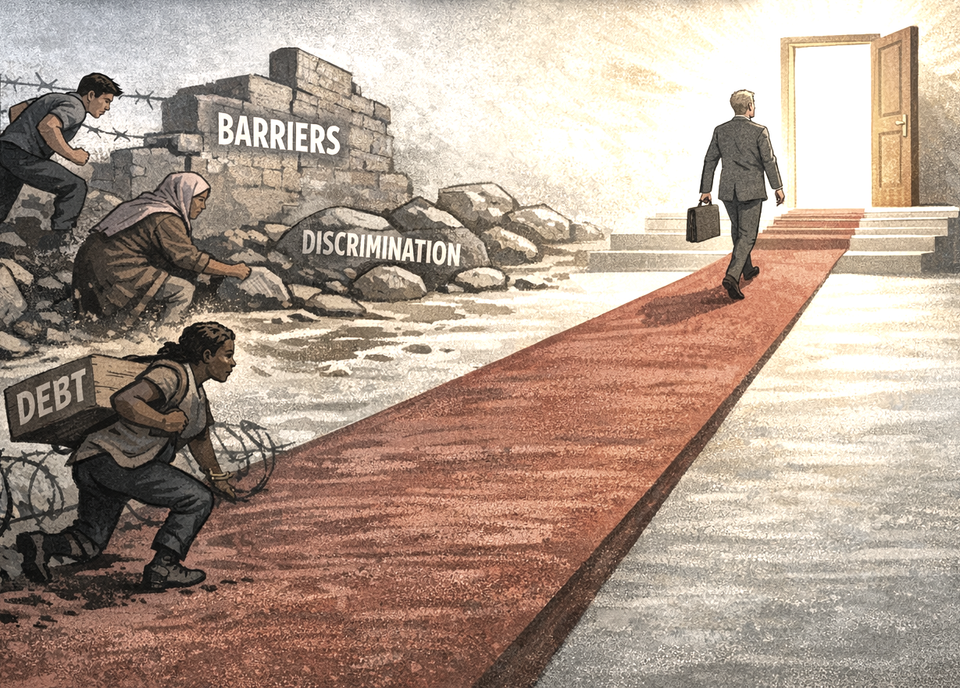
However, white privilege is real and it is at the root of what we are experiencing today. The degree and blatancy may not be what has gotten us here, but it continues to be real. All you have to do is post something on a social media asking white folks to stop appropriating something or doing something hurtful towards non-whites and you will see a whole bunch of white folk clutching their pearls in angst. While I acknowledge that the latter can be an anecdotal fallacy, it is something that we can probably all agree we have witnessed or participated in. We cannot dismiss our history and its effect on its people. We cannot look at the history of this country (or any country in this continent and surrounding islands) and not recognize that it was white privilege that built it while excluding others from benefiting and have the ability to build wealth and status that can then be passed onto future generations. And this lack of participation in wealth and power has affected non-white communities. Yes, it is improving. Yes, white Americans are experiencing greater numbers of economic disenfranchising and non-whites are experiencing financial gains. But the economic disproportion is still real and it affects communities in real ways. However, Harinam and Anderson support their argument by simply dismissing our history. They refuse to recognize how this historical inclusion impacts communities. They forget to mention that it was white privilege that deemed black Africans unworthy of humanity and therefore suitable slaves. It was white privilege that allowed the white individuals in power to conclude that Manifest Destiny afforded them the right to go from one end of the United States territory to the other end of the land mass, plundering, murdering, and displacing the peoples who were inhabiting the land being appropriated. It was white privilege that brought the Chinese to this country and when they got too successful working in the gold mines, factories, the fields, and building the railroads, white privilege helped enact the Chinese Exclusion Act in 1882, even though according to the census, they accounted for less than .2 percent of the population. It was most definitely white privilege that gave birth to colonization of the Americas. Harinam and Anderson dismiss the effects of historical trauma with “For the proponents of white privilege, differential group outcomes are a product of nefarious interventionism, past and present. Were it not for those meddling racists, equal outcomes would exist.” And they conclude their assertion paraphrasing the logic “if…then…” conditional argument example of “If it is raining, then the ground is wet.” An argument that is inherently flawed in this context because they are confabulating all outcomes into one conclusion. As a Latina, I live with the radical acceptance that were it not for colonization, I would not exist to write these words. I find their argument to discount the disproportion of African American participation in the criminal justice system painfully lacking. They focus their argument in numbers to justify basically more non-white people are involved in the criminal justice system because they commit more crimes, but they forget to discuss that it is not only culture that impact this outcome, structural conditions have a greater influence in criminality.
What I do agree with is that there is a ton of folks drowning in a glass of water whilst clutching their pearls, screaming “think of the children” as they bulldoze through opposing voices labeling them (insert identity/issue)-phobic. I have been accused of being transphobic because of my war survivor induced visceral reaction to using “x” instead of Latina to identify myself and my people, even after I insisted that I am willing to use it for those who so identify, and it was the first time that I was “okboomered”. Agism is A-OK if my cause is sufficiently righteous, I suppose (I even wrote a piece on it). The same day, while I was asking for civility and to let loving kindness lead the discussion, the righteous warriors swarmed-in advancing their campaign forward in a keyboard battle against “disgusting” “unethical” mental health professionals who simply had misunderstood the posting regarding “Always” removing the female symbol on their packages to be more gender inclusive, someone thought I was a man and accused me of using my male privilege to patronize and condescend women – apparently, it is also A-OK to make gender assumptions about people with foreign sounding names during gender inclusivity arguments.
It is this vicious, vitriol (on both sides, but I’m addressing the language police officers here) that makes it painful to try and engage in any discourse that might burgeon mastery over cognitive dissonance on a subject for individuals. We expect people to grow, learn, and reconsider their position instantly, while we refuse to do what we expect others to do. I had to check someone yesterday who threatened to get someone fired to rescue me from someone with whom I was playfully bantering – albeit politically inappropriatly. So, it is ugly out there in social-media-land. I recognize this. However, we cannot let the breakdown in civility influence what impacts the lived experiences of non-white compatriots. This is not a yes or no argument. It requires digging more into the numbers and our history. White privilege is a much more complex issue than Harinam and Anderson would have us believe with their overgeneralizations and misapplication of data. This piece could of have made a good argument against how white privilege is not experienced by all white individuals, how white Americans are increasingly experiencing poverty, how it may be on the decline, and they may even have been able to use some of their data – which was impressive by the way- without making illogical arguments full of fallacies to prove something that historical evidence has demonstrated just isn’t true.